Boost Your IELTS Writing Task 2 in Four Steps: Step 3 — Preparing and Using Your Evidence Bank
Improve your IELTS Writing Task 2 skills by learning to collect and apply strong evidence, use reasoning methods, and build a reusable evidence bank for persuasive essays.
Many test takers struggle with IELTS Writing Task 2 not because they can’t reach the word count, but because they run out of ideas. You may have a clear opinion and a solid essay structure, yet still find yourself lacking evidence to support your arguments. Evidence is the lifeblood of an argumentative essay—it determines whether your paragraphs feel convincing and substantial. Without strong supporting points, essays tend to either sound repetitive or rely on empty statements.
In the previous article, we explored how to structure your essay and connect ideas logically. The next step is to strengthen your arguments with solid evidence. Accumulating useful examples not only keeps your essay focused, but also provides an opportunity to showcase your vocabulary, sentence variety, and overall language skills.
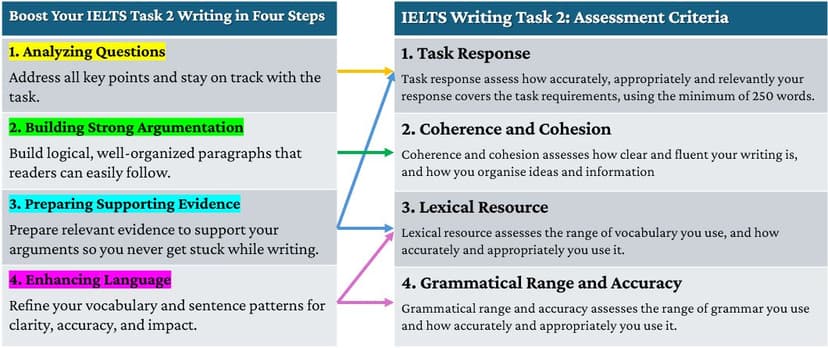
In fact, gathering and applying evidence is not as complicated as it seems. This article will break down the main types of reasoning and show practical ways to collect and use evidence, helping you move beyond “empty essays.”
Understanding Common Reasoning Methods to Use Evidence Effectively 📌
To avoid weak arguments, it’s essential to know how to support your points and place evidence strategically. Common methods include:
- Example-based reasoning: Present specific cases or phenomena and explain why they are representative and relevant to your point.
- Cause-and-effect reasoning: Describe a chain of reasoning, analyze the logical relationship, and show how outcomes support your claim.
- Comparative reasoning: Compare two practices, phenomena, or viewpoints to highlight advantages and disadvantages, supporting your position.
- Counterargument and refutation: Acknowledge opposing viewpoints, then logically refute them to emphasize the necessity or validity of your stance.
Below, we’ll examine examples of each method and highlight key points to consider when using them.
1. Example-Based Reasoning
Example-based reasoning is the most common and accessible method for IELTS test-takers. Here are some key points to keep in mind:
- Choose specific, impactful examples: Avoid overly personal anecdotes like “When I was in high school…” Instead, pick publicly known examples, such as news events, social phenomena, or widely recognized platforms.
- Ensure relevance: The example must directly support your point and clarify the logic you’re emphasizing. Ask yourself: Does this example clearly reinforce my argument? Does it help illustrate the reasoning behind my claim?
Sample:

This is a typical discuss-both-sides-question that explores the trade-off between whether the government should ban dangerous sports and whether individuals should have the freedom to make their own choices. The sample paragraph focuses on the side supporting government regulation. Rather than making a vague claim like “dangerous sports can lead to injuries,” it uses boxing as a concrete example of a risky sport. Boxing is closely associated with dangerous sports in general, and its long-term risk of brain injury has attracted widespread public concern. This specific example not only clarifies the point but also makes the argument more persuasive.
The paragraph also illustrates a useful technique in example-based reasoning—using a hyponym example. In other words, under the broader category of “dangerous sports,” the essay picks a specific, representative case—boxing—to support the argument. The same strategy can be applied to other topics as well. For instance, when writing about museums, one could cite Musée du Louvre; when discussing online content addiction, short video platforms could serve as a concrete example.
2. Cause-and-Effect Reasoning
Cause-and-effect reasoning depends on a clear chain of events. When used effectively, it demonstrates strong logical thinking.
- Maintain a clear and direct causal link: The cause should genuinely lead to the effect, which in turn should naturally support your argument.
- Go beyond surface explanation: Don’t just state what happens—explain why it happens and how it connects to your point. When using this type of reasoning, it’s essential that the cause and effect are logically connected, rather than pieced together arbitrarily. The cause you choose should be realistic and reliable, and the effect should naturally follow from it. Ask yourself: Does this cause genuinely lead to the effect? Does the effect directly support my argument?
Sample:

This is an agree-or-disagree question on whether celebrities are admired more for wealth and glamour than for achievements, and if this harms young people. The selected paragraph argues that by emphasizing wealth and charm over effort and talent, celebrities can distort young people’s values, encouraging unrealistic expectations and impractical attitudes.
The paragraph employs cause-and-effect reasoning by first identifying the cause—exposure to portrayals of instant success and fame—and then explaining the resulting psychological and behavioral consequences, such as the misconception that hard work is unnecessary, which may lead to disappointment, frustration, and a lack of motivation. Connectors like “consequently” and “leading to” help clearly mark the causal chain, making the argument structured and easy to follow.
In addition, the paragraph combines cause-and-effect reasoning with example-based argumentation, citing reality television as a concrete example. This not only makes an abstract phenomenon more tangible but also enhances the overall persuasiveness of the argument.
3. Comparative Reasoning
Comparative reasoning adds depth to your argument and helps readers grasp your stance more clearly.
- Choose clear and relevant targets: Make sure the items or options being compared share meaningful points of comparison.
- Clarify the angle of comparison: Consider dimensions such as outcomes, impact, cost, feasibility, or social value.
- Emphasize differences and advantages: Don’t just list facts—highlight why one option is preferable or more effective than the other.
Sample:

This sample question asks: “People are wearing western-style clothes rather than more traditional clothes. Why is this? Is it a negative or positive development?” It is a combined essay type that involves analyzing causes and discussing advantages and disadvantages. In the paragraph under review, the stance is that the advantages outweigh the disadvantages, and the paragraph focuses on discussing the positive aspects.
The paragraph highlights two main advantages of western-style clothes: practicality and durability, including ease of cleaning and maintenance. From these angles, it compares western-style and traditional clothing, using connectors like "in contrast" and "whereas" to make the differences clear and emphasize the comparison. The paragraph then summarizes the results of the comparison, leading to a conclusion that reinforces the central argument of the section.
4. Counterarguments and Refutation
Acknowledging opposing views before refuting them can make your essay stronger and more persuasive.
- Refute logically: Avoid simply denying the opposing view. Instead, use examples, comparisons, or cause-and-effect reasoning to demonstrate its limitations or misconceptions.
- Reinforce your stance: After addressing the counterargument, make sure to return to your main point. The purpose of acknowledging the opposition is to strengthen—not weaken—your original argument.
Sample:

From the same sample question as above, this paragraph serves as the counterargument section, addressing potential disadvantages while ultimately offering a concession-refutation.
The paragraph begins by presenting the opposing view, acknowledging that overreliance on western-style clothing could weaken traditional attire and cultural identity. It then uses a "Nevertheless" transition to point out that traditional clothing is still preserved for festivals, weddings, and other special occasions, thereby mitigating the negative impact. The paragraph concludes by refuting the counterargument and returning to the main point—although there are potential drawbacks, they do not outweigh the practical advantages of western-style clothing.
⏳ How to Build an Evidence Bank for IELTS Writing Task 2 Efficiently
One common mistake when accumulating writing material is memorizing lots of fancy sentences or examples. On exam day, you may find that these “ready-made” examples don’t match the question at all and end up being useless. So, how can you efficiently and purposefully collect supporting evidence for your essays?
1. Extract from model essays rather than rote memorization
When reading a high-quality model essay, focus on how the essay is constructed and developed, rather than simply memorizing sentences or examples. To break down and accumulate a strong argument paragraph, consider:
- Argument techniques: Which reasoning methods are used? How is the argument developed?
- Sentence transitions: How are ideas connected? Which logical connectors or signposts are employed?
- Specific examples: If the paragraph includes examples, first summarize them in your own words. Then compare your phrasing with the original to identify useful vocabulary or sentence patterns you can adapt flexibly.
In your writing practice later on, you can apply these examples and logic to similar topics, rather than mechanically copying templates.
2. Organize examples by common topics
Common IELTS Task 2 topics include education, technology, media, work, social life, environment, culture, government, crime, urbanization/globalization. After each practice essay or model essay reading, categorize examples by topic and further distinguish whether they support or oppose a certain viewpoint. This allows you to quickly access relevant examples and argument points during the exam, avoiding the “no ideas” problem and building a systematic resource library.
3. Review and supplement examples after practice
During timed practice, it’s normal not to have enough time to review or think of additional supporting evidence. However, after completing a practice essay, it’s important to revisit your argument and think about other examples or reasoning you could add. These extra examples aren’t meant to be forced into the current essay—they expand your thinking and enrich your resource bank for future essays.
💡 Recommended Platform: LingoLeap
AI tools can also help improve efficiency in this process. For example, Lingoleap offers topic-specific IELTS writing resources and example suggestions. After a simulated essay, it can provide not only scoring and detailed feedback but also supplementary examples aligned with your argument style, helping you review and accumulate evidence more effectively.
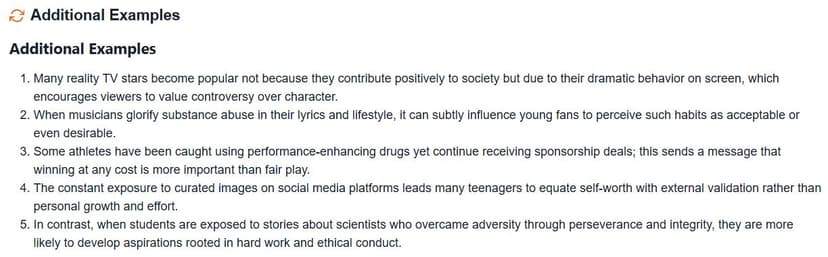
By following this approach, you save time searching for examples and gradually build a structured library of reusable evidence, preparing you well for both practice and the actual exam.
💬 Summary & Next Steps
Evidence is the lifeblood of any essay. No matter how clear your ideas are or how well-structured your paragraphs might be, without solid examples and strong support, your arguments will still struggle to convince the reader. By systematically collecting, organizing, and flexibly applying your evidence, you can make each paragraph richer and far more persuasive.
Once you’ve mastered effective ways to gather and use supporting material, you’ll approach exam writing with much greater confidence. Looking back at the first three steps of our “Four-Step Approach,” we can already produce essays that stay tightly on topic, follow a clear logical flow, and are backed by solid evidence. But to truly elevate your writing and make your words shine, there’s one final step: enhancing your language.
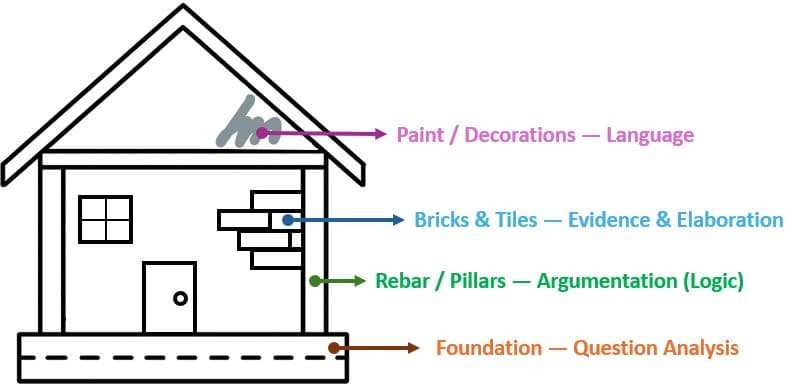
In the next article, we’ll focus on this final stage—exploring how to enrich your writing through vocabulary, sentence structures, and expressions. You’ll learn how to make your IELTS essays more dynamic, engaging, and persuasive, turning well-reasoned arguments into truly compelling writing.