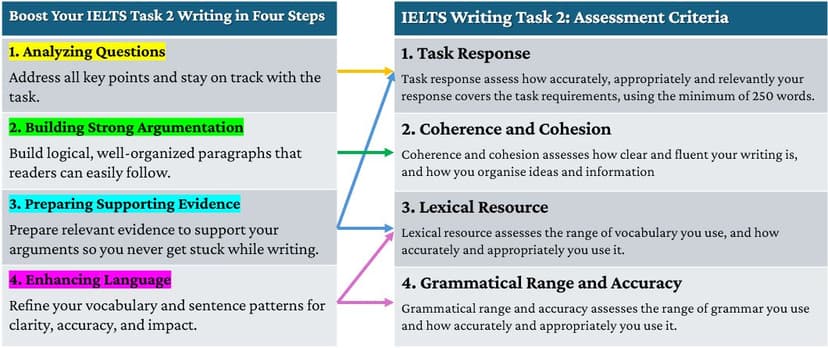
Boost Your IELTS Writing Task 2 in Four Steps: Step 2 — Building Stronger Arguments and Logical Paragraphs
Achieve higher IELTS Writing Task 2 scores by building logical frameworks, using PEEL and Hamburger structures, and applying natural linking strategies.
In the previous article, we focused on the first step to improving your IELTS Writing Task 2: analyzing the question. Understanding the question, identifying keywords, and defining your main viewpoint lays the groundwork for a good essay.
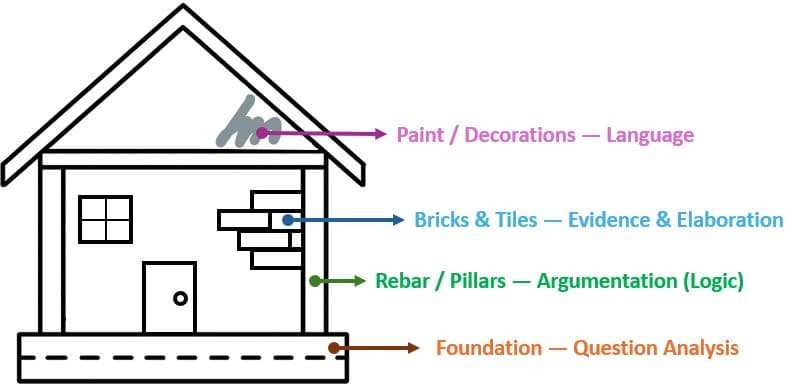
Once you can stay on topic, the next challenge is presenting your ideas in a clear and convincing way. Strong reasoning acts like the framework of a house: it provides structure and support, allowing the evidence you add later to fit in securely.
In this article, we’ll move on to Step 2 of our four-step strategy: Building Coherent and Cohesive Argumentation.
We’ll focus on two things: making your reasoning clear and solid, and making sure your sentences and paragraphs flow smoothly. With these skills, your essay will read more structured, logical, and convincing.
✒ How to Structure a Logical Paragraph
To write a logically sound argument, you need to have a well-structured paragraph, and then carefully “fit in” your supporting evidence. How clearly and coherently a paragraph is organized directly affects whether your reasoning comes across as strong and smooth. Here are two of the most commonly used paragraph structures:
1. PEEL Paragraphs
When a paragraph centers on a single main point, the PEEL model is especially useful. It helps you stay focused and develop your ideas thoroughly. PEEL stands for Point, Evidence, Explanation, and Link:
- Point: Introduce your point directly.
- Evidence: Support your point with an example, statistic, case study, or real-world observation.
- Explain: Explain how this evidence supports your argument.
- Link: Summarize the paragraph and link it back to the main point or the next idea.
This structure is especially useful for in-depth analysis of a single idea, making your reasoning both thorough and coherent.
Example:
A family has a great influence on children's development, but the outside of home plays a bigger part in children's life. To what extent do you agree or disagree?
Sample Body Paragraph:
This is an “Agree or Disagree” type of question. Suppose your essay takes the view that while family education is important, schooling and online media outside the home have an even greater impact on a child’s development. The first body paragraph can use the PEEL model to focus on the role of schooling:
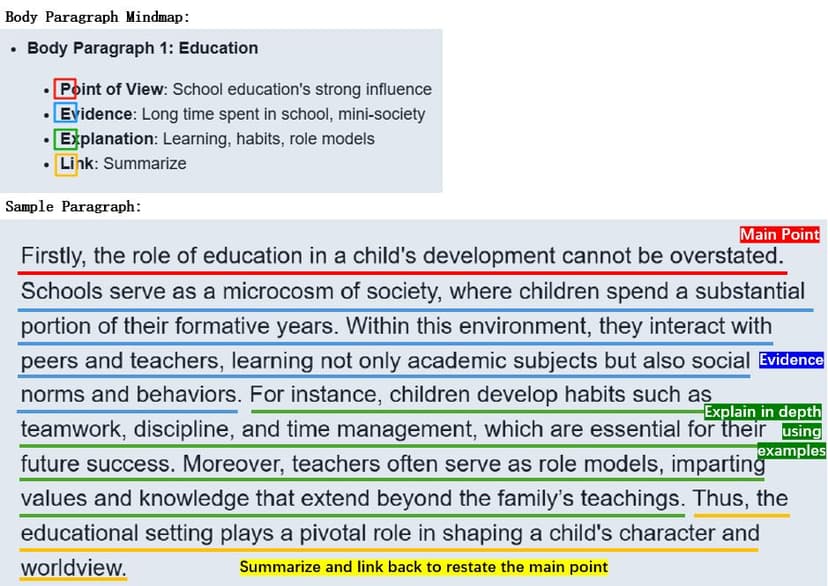
As shown in the example, the paragraph begins with a clear topic sentence that signals it will discuss the influence of schooling. Next, provide evidence: school is like a small society, where children spend a large portion of their time and interact with many people. Then, explain and analyze: describe the specific influences children experience in this environment and why these influences are significant and far-reaching. Finally, wrap up the paragraph with a sentence that summarizes the point and reinforces your argument.
By following the PEEL structure, the test reviewer can clearly see how your reasoning unfolds step by step, which makes your analysis both easy to follow and convincing.
2. Hamburger Paragraphs
When you want to discuss two or more related sub-points in a single paragraph, the "hamburger" structure works best. Imagine your paragraph as a layered burger:
- Top Bun (Topic Sentence): State the central idea of the paragraph.
- Fillings (Sub-points + Evidence): Present 2–3 parallel sub-points, each with its own supporting elaboration or example.
- Bottom Bun (Concluding Sentence): Wrap up the paragraph by reinforcing the central idea or preparing for the next argument.
Example:
In many countries today people are living in a ‘throw-away society’ , where things are used in a short time and then thrown away. What are its causes? What are its problems?
Sample Body Paragraph:
Let’s look at the first type of explanatory question—analyzing causes—as an example. Since the prompt asks “What are its causes?”, your essay should cover at least two different reasons. If you put them in the same body paragraph, treat them as parallel sub-points, and support each one with examples or explanations. This is where the hamburger structure comes in handy:
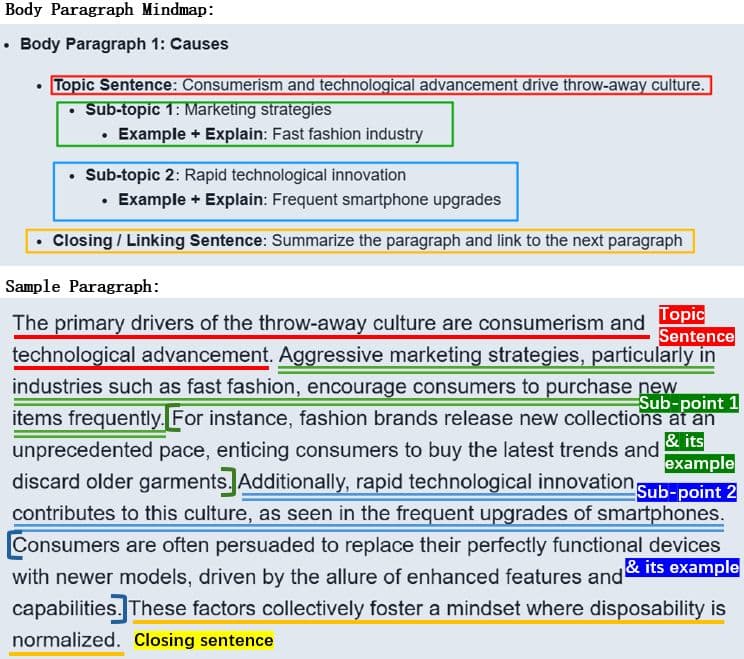
Here, the two supporting ideas are presented clearly and backed up with appropriate examples and explanations. This makes the body paragraph concise yet well-developed, with each idea fully and logically discussed. When planning an outline, you can map out this kind of structure in advance. Doing so not only helps you stay focused while writing, but also allows the examiner to follow the logical flow of your argument more easily.
🔗 How to Connect Sentences and Paragraphs for Smooth Flow
Strong reasoning structure is not enough on its own—your essay must also flow naturally. If your ideas jump around without clear links between them and your sentences or paragraphs feel disconnected, the logic of your argument can get lost, which will lower your score.
1. Linking Paragraphs: Set a Clear Direction
Every paragraph should open with a topic sentence that clearly signals its focus. This not only satisfies the Task Response criterion but also ensures the essay reviewer immediately understands where your argument is heading.
Example:
Some people think that it's good for a country's cultures to show imported foreign film and TV programs. Other people think that country should develop their own film and TV programs instead. Discuss both sides and give your own opinion.
IELTS Band 8 Sample Response:
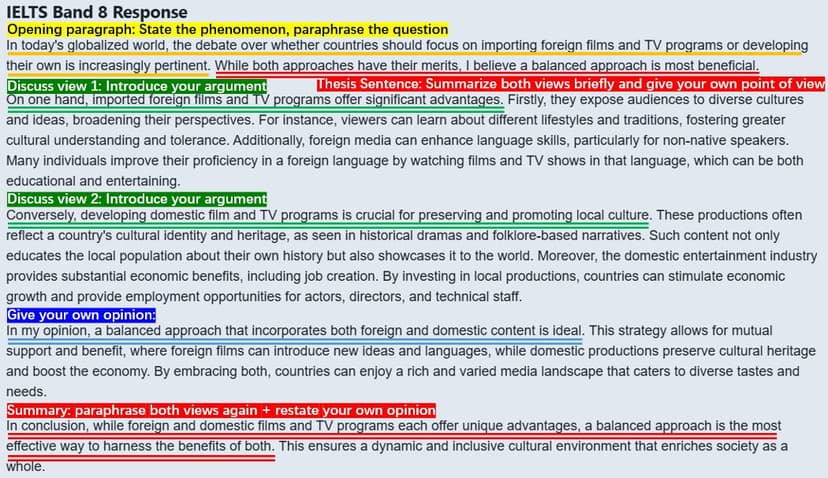
In this Band 8 sample essay, the structure is clear and consistent: the introduction and conclusion are concise and direct, and each body paragraph begins with a strong topic sentence that sets up the focus of the discussion. This makes the essay easy to follow from start to finish.
2. Linking Sentences: Use Appropriate Linking Words
Good cohesion is about using linking devices naturally and selectively—not stuffing your essay with “Firstly, Secondly, Thirdly.”
Recommended practices ✅:
- Natural openers at the start of sentences: "On the one hand", "In contrast", "As a result"
- Flexible transitions within sentences: "Some argue that…, however, I believe…"
- Reference words: "this trend", "such behavior", "the issue mentioned above"
🚩 Avoid:
- Overusing formulaic transitions like ”Firstly", "Secondly", "Thirdly"
- Repeating "In conclusion" or "To sum up" unnecessarily, especially in body paragraphs.
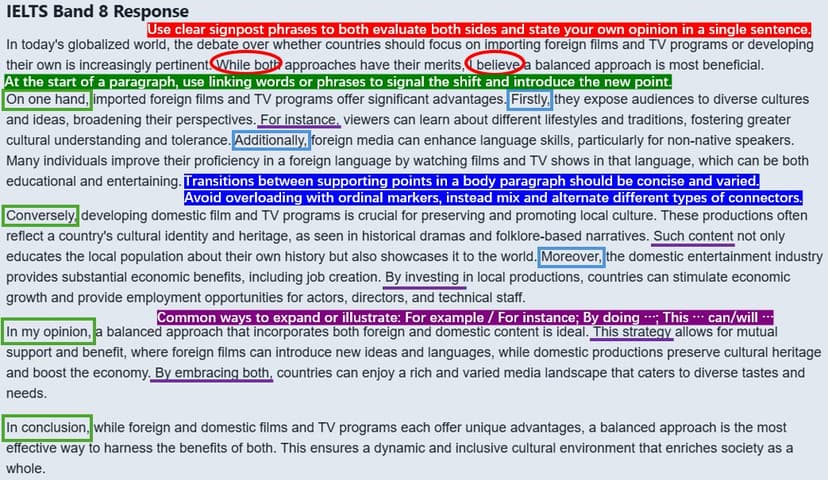
Looking at the same sample essay again, you can see that the transitions are not about quantity or fancy vocabulary. What matters is using them naturally, accurately, and with variety. Linking words act as signposts, showing the reader how your ideas connect and where your argument is heading. They need to match the logical structure of your essay—used in the right place, not overused or added mechanically. By varying your connectors with similar functions, you can improve your essay's vocabulary, create smoother transitions, and make your writing feel natural.
💡 Recommended Platform: LingoLeap
Building a logical framework is one thing—making sure it actually works in practice is another. This is where many learners get stuck: you sketch an outline, but you’re not sure if it holds together, or you write an essay and can’t tell why the reasoning feels weak. LingoLeap helps close that gap.
Within its IELTS Writing Task 2 module, you can:
- Turn outlines into model essays: input your logical framework and see how a full essay would look when built around it.
- Get real scoring and feedback: receive grades aligned with IELTS Band Descriptors, so you know exactly where you stand.
- Visualize your essay structure: auto-generated mind maps show the flow of your argument at a glance.
- Fix weak spots fast: pinpoint gaps in reasoning or poor transitions, and get clear suggestions for improvement.
Instead of practicing blindly, you’ll train both your thinking process and writing output—making every essay a step toward a stronger, more coherent performance.
💬 Summary & Next Steps
Having mastered question analysis and argumentation techniques, we’ve now completed the first two essential steps of our "four-steps" approach to boost IELTS Writing Task 2. Like our previous analogy with building a house, you can now lay a solid foundation and a sturdy framework.
But having a structure alone isn’t enough. Just as a building without walls remains hollow, an essay without strong and concrete content feels empty. That’s why the next step is all about filling your essay with convincing evidence and examples.
As mentioned in the first article (Boost Your IELTS Writing Task 2 in Four Steps: Step 1 — Analyzing Questions for Accurate Responses), IELTS Writing Task 2 covers a huge range of topics—from smaller ones like education, work, and personal life to bigger ones like government policy and social development. With so many topics, how can you efficiently gather relevant knowledge and turn it into strong supporting evidence for different types of essays?
In the next article, we’ll move on to Step 3—Preparing and Applying Evidence.
We’ll show you how to efficiently gather topic-related resources, extract reusable examples, and apply them flexibly across different question types—so your essay is not only logically solid but also rich in content.