Boost Your IELTS Writing Task 2 in Four Steps: Step 1 — Analyzing Questions for Accurate Responses
Boost your IELTS Writing Task 2 scores by mastering question analysis. Stay on-topic, cover key points, and lay the groundwork for Band 7+.
When preparing for IELTS Writing Task 2, many test takers face the same frustration:
I've read many sample essays and practiced a lot, but my actual test scores just won't improve.
The truth is, achieving a steady Band 6.5—or pushing toward Band 7 and beyond—takes more than simply extensive reading and writing. The IELTS Writing test measures a broad set of skills: analyzing the question accurately, building a logical and coherent argument, supporting your ideas with relevant evidence, and expressing yourself with varied and precise language.
That’s why we created the Boost Your IELTS Writing Task 2 in Four Steps series. This step-by-step guide is designed to help test takers systematically strengthen their writing skills, comprehensively covering the key aspects of the official IELTS Writing Task 2 Band Descriptors:
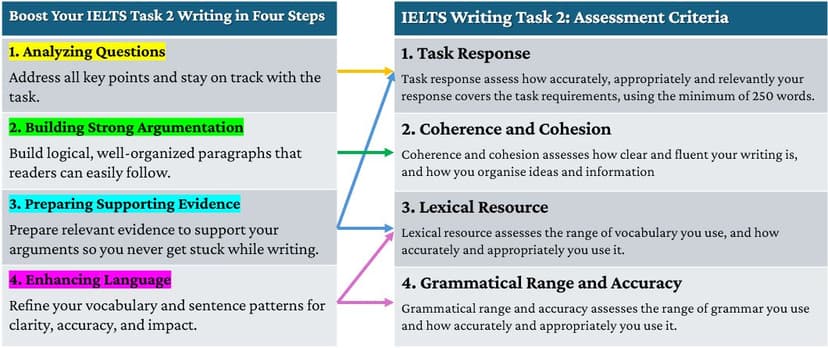
In this very first article, we’ll begin with Step 1—Question Analysis.
Analyzing Questions is the foundation of mastering IELTS Writing Task 2. Staying on-topic not only ensures a solid base score but also lays the groundwork for higher bands. In this article, we’ll cover:
- Why analyzing questions is critical
- The 4 main question types and 10 common topics
- A step-by-step method for analyzing any question accurately
❗ Why Question Analysis Matters in IELTS Writing Task 2
In the official IELTS Writing Band Descriptors, Task Response is one of the main criteria that is directly tied to how well you answer the question:
- Band 6: The main parts of the question are addressed (though some may be more fully covered than others).
- Band 7: The main parts of the question are appropriately addressed.
- Band 8: The question is appropriately and sufficiently addressed.
Clearly, covering all aspects of the question without going off-topic is essential for building a high-scoring essay. But analysis goes beyond understanding the surface meaning. You must identify the deeper requirements. The more thoroughly you interpret the question, the more focused and effective your essay will be.
I. The Four Main IELTS Writing Task 2 Questions
IELTS Writing Task 2 questions basically fall into four broad categories. Each type requires a slightly different structure:
Type 1: Discussion
- Feature: Discuss both views and give your own opinion.
- Approach: Present both perspectives, then state and justify your stance.
- Sample structure:
- Intro: Background + mention both views
- Body Paragraph 1: Analyze view 1
- Body Paragraph 2: Analyze view 2
- Body Paragraph 3: State and justify your opinion
- Conclusion: Summarize both views and restate your own point
- Key Tip: The two views are not always completely opposite. Do not assume they’re strictly contradictory.
Example:
Some people think that it's good for a country's cultures to show imported foreign film and TV programs. Other people think that country should develop their own film and TV programs instead.Discuss both sides and give your own opinion.
Sample Mindmap (Structure):
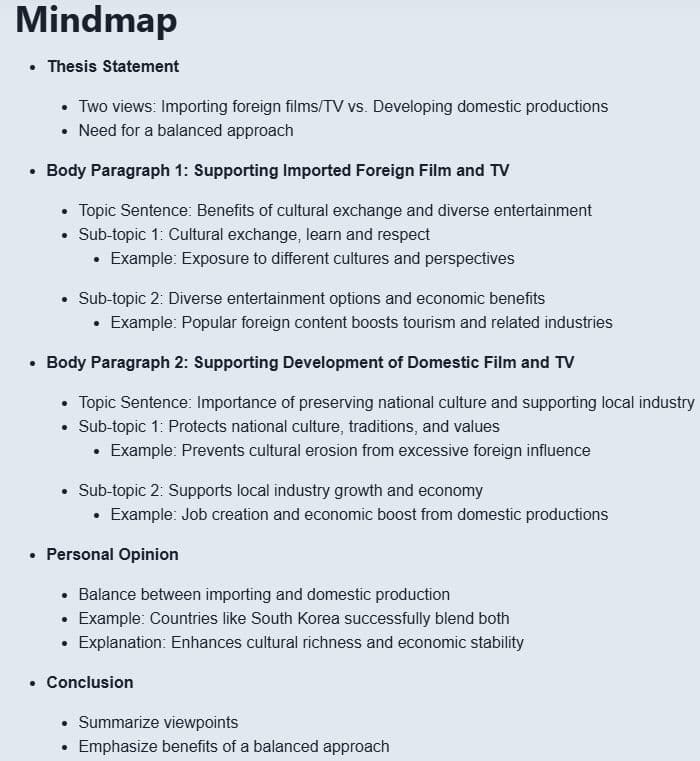
When analyzing this question, the key is to accurately identify the two views provided:
- View 1: Support importing foreign media.
- View 2: Support developing local media.
- Note: These two are not strictly opposed to each other. It is not a “for vs. against” debate.
Type 2: Agree or Disagree
- Feature: Do you agree or disagree? / To what extent do you agree or disagree?
- Approach: State your position clearly and support it with valid reasons.
- Sample structure:
- Intro: Background + clear opinion
- Body Paragraph 1: Reason 1
- Body Paragraph 2: Reason 2
- Body Paragraph 3: Counterargument (Optional)
- Conclusion: Restate opinion
- Key Tip: If the question asks “to what extent”, make sure you indicate the degree (totally, mostly, partly, slightly agree/disagree) clearly instead of just saying "I agree.../disagree...".
Example:
Some people think young people should be required to have full time education until they are at least 18 years old. To what extent do you agree or disagree?
Sample Mindmap (Structure):
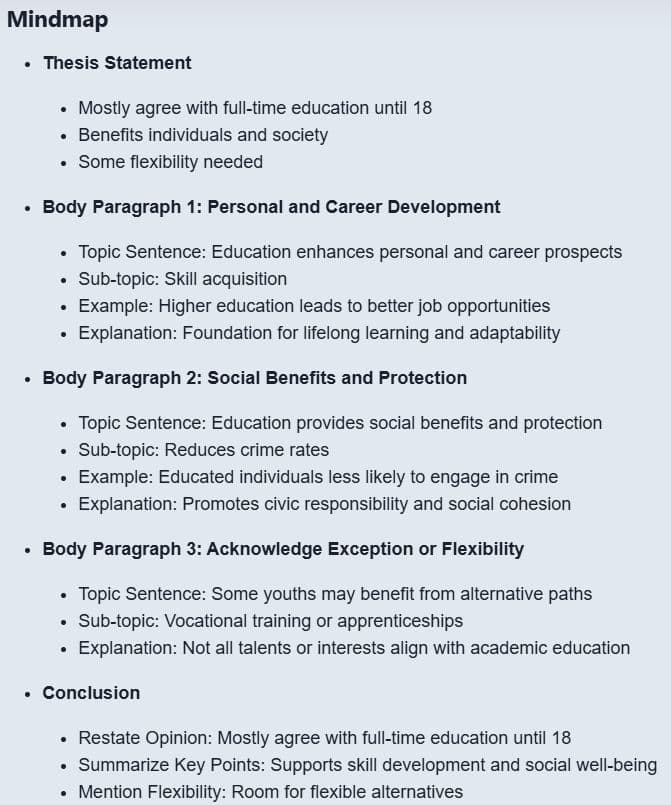
When analyzing this question, the key is to state your opinion clearly and address it thoroughly:
- Clearly express the degree of agreement: not just a simple “agree” or “disagree,” but show nuance — for example, using “mostly agree.” A flexible stance is often closer to real-world reasoning.
- When you say “mostly agree,” you also need to explain "why you agree but not entirely". In other words, after discussing the supporting reasons, you should also cover the smaller part where you do not fully agree.
Type 3: Advantage & Disadvantage
- Feature: Do you think the advantages outweigh the disadvantages? / Is it a positive or negative...?
- Approach: Discuss both pros and cons, then make a clear judgment.
- Sample structure:
- Intro: Background + give overall stance (advantages outweigh disadvantages, etc.)
- Body Paragraph 1: Advantage 1
- Body Paragraph 2: Advantage 2
- Body Paragraph 3: Disadvantages (acknowledge but counter)
- Conclusion: Reinforce stance
- Key Tip: If the question uses plural forms (advantages/disadvantages), you should also include more than one point for each side.
Example:
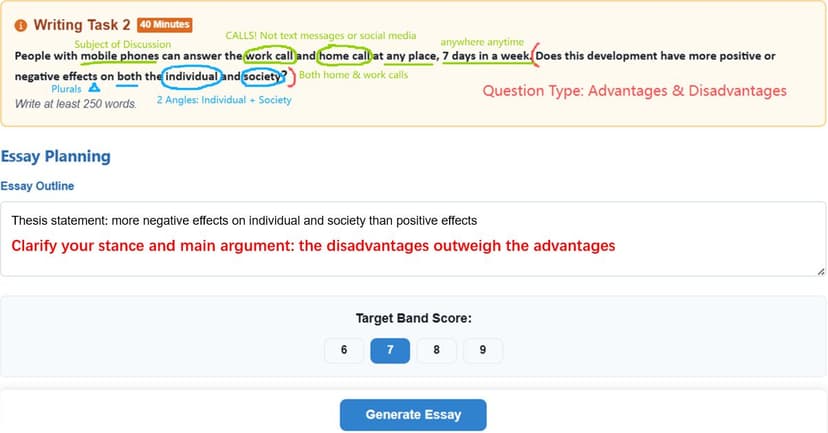
People with mobile phones can answer the work call and home call at any place, 7 days in a week. Does this development have more positive or negative effects on both the individual and society?
Sample Mindmap (Structure):
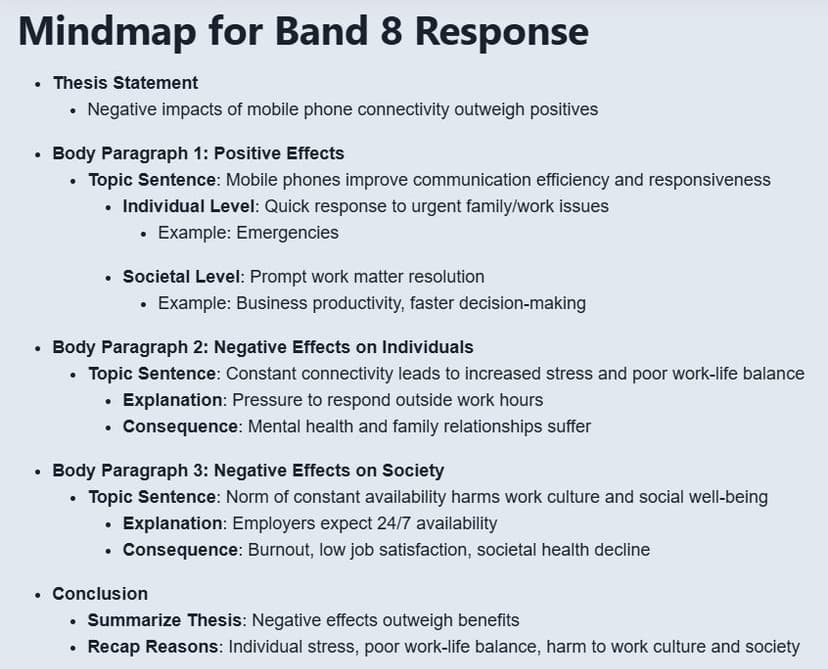
When analyzing this question, the key is to develop a clear structure that addresses all parts of the task in a comprehensive way:
- Since the question is phrased as “have more positive or negative effects,” you should go beyond simply listing advantages and disadvantages, and instead make a clear argument as to why one side is more significant than the other.
- Pay attention to the qualifier “on both the individual and society.” Your analysis should address both dimensions, explaining how the issue influences individuals and society respectively in positive and negative ways.
Type 4: Explanatory Essays
- Feature: Problem / Importance / Cause & Effect / Solution
- Approach: Depending on the specific question requirements, you may be asked to address a combination of tasks, such as analyzing the reasons, explaining the impacts, proposing solutions, or discussing the advantages and disadvantages.
- Sample structure:
- Intro: State the problem
- Body Paragraph 1: Causes/reasons (depends on the specific questions)
- Body Paragraph 2: Effects/solutions (depends on the specific questions)
- Conclusion: Summarize key points
- Key Tip: If the question uses plural (e.g., causes, suggestions), cover at least two points for each.
Example:
The world of work is changing rapidly and people cannot depend on the same job or same conditions of work for life.Discuss the possible causes for this rapid change and give your suggestions on how people should prepare for work in the future?
Sample Mindmap (Structure):
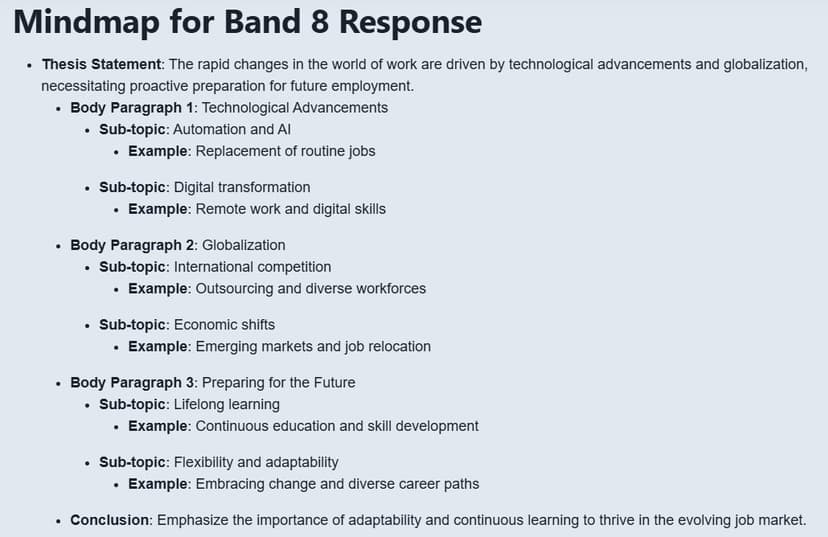
When analyzing this question, the key is to break down the task and identify the keywords:
- The question consists of two parts: analyzing the causes + proposing solutions. Your essay should clearly cover both parts through a logical structure and well-defined paragraph topics.
- Pay attention to plural terms such as “causes” and “suggestions.” Whether discussing causes or solutions, you should address multiple perspectives and aspects, avoiding one-sided or superficial answers.
- Note the scope indicated by the question: “this rapid change” requires focusing the cause analysis on current factors, while “in the future” emphasizes that proposed solutions should look ahead and address future challenges.
II. IELTS Writing Task 2 Common Topics
Although IELTS Writing Task 2 covers a wide range of topics, they generally fall into ten broad themes:
- Education📚 (curriculum, teaching methods, learning approaches)
- Technology (Internet, IT, modern tech) 💻
- Media (celebrities, influencers, news, multimedia)
- Work💼 (work-life balance, careers, workplace issues)
- Social Life (aging, personal development/lifestyle, social issues)
- Environment (energy, climate change, conservation) 🌏
- Culture (heritage, traditions, cross-cultural exchange)
- Government (public services, policies, investment & spending)
- Crime (youth crime, cybercrime, law & punishment) 👮
- Urbanization/Globalization (migration, rural-urban gap, trade)
Familiarizing yourself with common topics and having a ready set of vocabulary and examples can make it much easier to plan your essay quickly and help you avoid going off-topic.
III. Best Practices for Analyzing IELTS Writing Task 2 Questions
Developing the habit of analyzing questions carefully can greatly improve writing efficiency and quality. Here is a five-step method to guide your analysis after reading the task:
1. Identify the Question Type
Find the instruction prompt (e.g., “Discuss both views”, “To what extent do you agree or disagree?”, “Advantages and disadvantages”) to quickly determine the question type.

2. Highlight Keywords
Keep an eye on keywords in the question. Note plurals/singulars, determiners, and connectors (and/or), wtc. These cues signal how many points and what scope you must cover—helping you avoid going off-topic.

3. Map out Requirement Layers
Break the prompt into parts: how many issues, from which angles, and what points to cover. Some prompts seem straightforward but hide multiple layers or comparisons.

4. Define Your Central Argument
Decide your main stance and jot it down. Then check it against Steps 1–2 to ensure it directly responds to the core question and aligns with all the keywords.
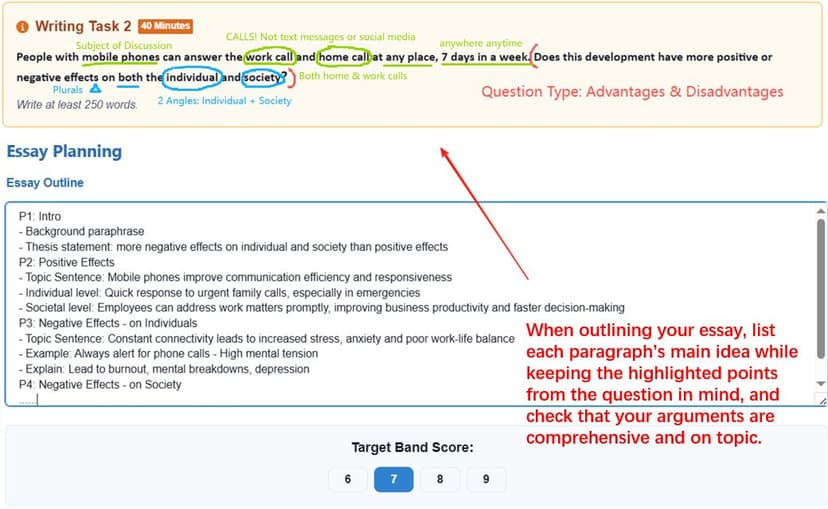
5. Draft the Outline
Sketch each paragraph’s topic sentence and supporting points. Keep the structure clear and non-repetitive, and check against Step 3 to ensure all aspects of the task are covered.
IV. Effective Practice Starts with the Right Platform
Mastering question analysis and writing techniques is just the beginning. Real progress comes from consistent practice and actionable feedback. Yet many test-takers run into the same roadblocks: “I don’t know how to start” or “I have no idea what’s wrong with my writing.” At this point, having a platform that helps you organize your thoughts and provides immediate feedback can be a game-changer.
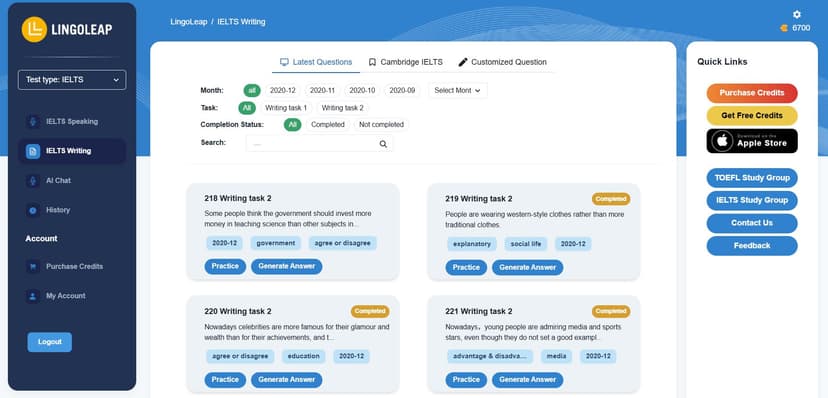
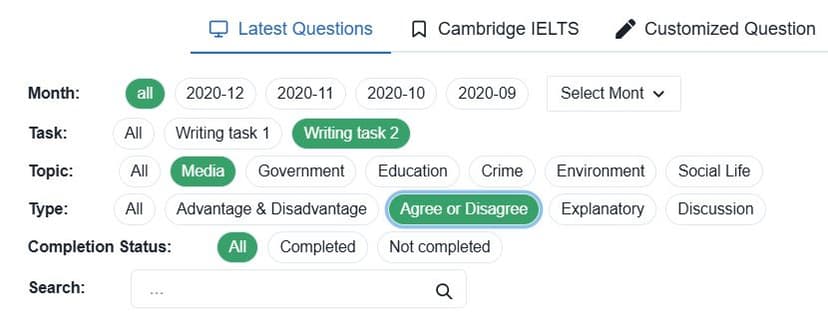
LingoLeap is a platform built specifically for IELTS and TOEFL preparation. It offers a rich bank of real test writing questions and can generate reference materials to guide your stance, reasoning, and structure—helping you break through the common “staring at a blank page” struggle. With its topic- and question-type filters, you can also target specific areas for training and put the question analysis methods from this article into real practice.
Most importantly, LingoLeap comes with an AI-powered evaluation system that scores your writing across multiple dimensions—language, structure, and logic—mirroring real test standards. This means no more spending hours on an essay only to receive zero feedback. Instead, you’ll enter a powerful cycle of write, review, improve—and see measurable growth.
💬 Summary & Next Steps
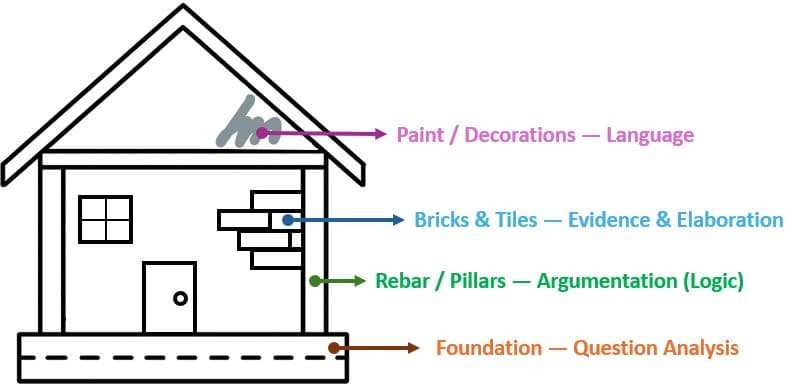
Completing an IELTS writing task 2 is like building a house. The first step—question analysis—is your foundation. Without a solid foundation, even the best vocabulary and complex sentences won’t save your essay from drifting off-topic.
So, if you’ve read or even memoried many sample essays but still find your writing stuck around a Band 6-6.5, try investing more time in analyzing the question. With the right method, you’ll be prepared to tackle any question type or topic with confidence.
In the next article, we’ll move to Step 2: Building Strong Argumentation, where we’ll explore how to make your essay not only on-topic but also persuasive.