What a Band 6 Means in TOEFL 2026 Speaking
TOEFL 2026 reports Speaking as a single section score on the 1–6 scale. This overall band reflects your combined performance across both Speaking task types: Listen and Repeat and Take an Interview. Each task type is scored using its own set of criteria.
Listen and Repeat
Scored on repetition accuracy and intelligibility. A Band 6 performance means you reproduce sentences precisely, with clear and natural-sounding delivery.
Take an Interview
Scored on relevance, elaboration, fluency, vocabulary, grammar, and pronunciation. A Band 6 performance means fully relevant, well-developed responses delivered with natural speech.
Important: the official ETS TOEFL Speaking page and the ETS scoring documentation describe the dimensions evaluated for each task but do not publish the exact formula that converts task-level scores to the 1–6 section reporting band. What is clear is that consistent high performance across both task types — accuracy in Listen and Repeat, and communicative effectiveness in the Interview — is required for the highest section score.
For the full explanation of how TOEFL 2026 scores are calculated, see the full 2026 scoring guide.
Listen and Repeat: Path to Band 6
The Listen and Repeat task plays a spoken sentence. Your task is to repeat it back as accurately and clearly as possible. The two core scoring dimensions are repetition accuracy and intelligibility — see the Listen and Repeat strategies guide for drill techniques.
Repetition Accuracy
Reproduce the exact wording, word order, and meaning of the sentence. Replacing, dropping, or reordering words — even if the result sounds natural — lowers your score. Every word in the original sentence matters. Band 6 responses preserve the sentence with near-perfect fidelity.
Intelligibility
Your pronunciation must be clear enough that what you say is immediately understood. A non-native accent is not penalized, but mispronunciations that make words difficult to identify reduce your score. Consistent clarity across the full response is what earns the top band.
Connected Delivery
Band 6 responses are delivered as a connected, natural phrase — not word by word. Choppy delivery broken at every word suggests difficulty holding the sentence in memory and signals lower spoken fluency.
Key practice habit
Record your Listen and Repeat responses and compare them directly to the original audio. Train your ear to catch substitutions, dropped words, and pronunciation gaps. Shadowing native-speaker audio is the most effective single exercise for this task.
Take an Interview: Path to Band 6
The Interview task asks you to respond spontaneously to a question. Band 6 performance requires strong marks across six dimensions evaluated simultaneously. For an adaptable response framework, see the Speaking Interview Template.
Direct Relevance
Your response must answer the exact question asked. Vague answers or responses that drift off-topic are penalized regardless of how fluently they are delivered. State a clear position and stay on it.
Coherent Elaboration
Support your position with at least one specific reason, example, or detail. Band 6 responses do not stop at a single sentence of opinion — they develop the idea in a way that is easy to follow.
Natural Fluency
Speech should flow continuously with minimal hesitation. Occasional natural pauses for thought are expected, but frequent fillers, long silences, or restarted sentences suggest difficulty with spoken production.
Natural Pronunciation and Intonation
Band 6 responses use natural stress patterns and intonation — not just intelligible pronunciation, but speech that sounds communicatively effective. Monotone or flat delivery can reduce this score even when individual sounds are clear.
Precise Vocabulary
Use varied, topic-appropriate vocabulary. Relying on a small set of basic words or overly general language signals limited lexical range. Band 6 responses show the ability to express nuanced ideas with appropriate word choices.
Grammatical Control
Minor grammatical errors are expected and acceptable at Band 6. What is not acceptable is repeated structural errors that interfere with meaning or that suggest a lack of command over sentence structure.
Rubric Breakdown at Band 6
The table below summarizes what Band 6 performance looks like across both Speaking tasks.
| Rubric Dimension | Listen and Repeat | Take an Interview |
|---|---|---|
| Accuracy / Relevance | Near-exact wording, all words preserved | Response directly addresses the question |
| Intelligibility / Pronunciation | Clear, understandable throughout | Consistent clarity with natural intonation |
| Delivery | Smooth, connected phrase delivery | Natural fluency, minimal hesitation |
| Elaboration | N/A (task is repetition only) | Specific reason or example developed clearly |
| Vocabulary / Grammar | N/A (task is repetition only) | Varied vocabulary, grammatically controlled |
What Band 6 Responses Look Like
Recognizing the characteristics of a Band 6 response helps calibrate your own production. Here is what strong performance looks like for each task.
- ✓Reproduces the sentence with exact or near-exact wording
- ✓Delivers the sentence as a single connected phrase, not word by word
- ✓Maintains consistent clarity throughout — every word is easily recognized
- ✓Controls pace and volume for easy comprehension
- ✓No substituted, dropped, or reordered words
- ✓Opens with a clear, direct answer to the specific question asked
- ✓Follows up with at least one specific, logically connected reason or example
- ✓Speaks in natural, flowing sentences without long pauses or restarts
- ✓Uses topic-appropriate vocabulary with natural stress and intonation
- ✓Keeps grammatical errors minor and meaning-preserving throughout
Why Test-Takers Miss the Top Band
Understanding the most common reasons speakers fall short of Band 6 helps you identify and fix gaps in your own responses.
Substituted or Dropped Words (Listen and Repeat)
The most common accuracy error. Even one substituted or dropped word reduces your score for that response. Train yourself to hold the full sentence in working memory before speaking.
Word-by-Word Delivery (Listen and Repeat)
Repeating a sentence as a series of disconnected words signals poor memory chunking and limited spoken fluency. Practice delivering full sentences as one connected breath.
Vague or Off-Topic Answers (Interview)
Answering a related but different question, or giving a general statement that does not directly address the prompt, is one of the most costly interview errors.
Unsupported Opinions (Interview)
Stating a preference or opinion and stopping there is not sufficient for Band 6. Every interview response needs at least one clear, specific supporting detail.
Pronunciation Errors That Affect Understanding
Consistent mispronunciation of high-frequency words reduces intelligibility across both task types. Accent is not penalized — lack of clarity is.
Monotone Delivery (Interview)
Flat, robotic-sounding speech undermines the intonation criterion even when individual words are pronounced correctly. Natural spoken English has varied pitch, stress, and rhythm.
Practice Strategies for Band 6
Effective Band 6 preparation addresses each task type on its own terms. Here is what consistent practice should include.
Daily shadowing practice
Shadow native-speaker audio by repeating sentences immediately after hearing them. Start with 8–10 word sentences and progressively increase length. This trains both memory capacity and speech fluency together.
Compare and gap analysis
Record your repetitions and compare them to the source audio. Identify substitutions, dropped words, and pronunciation differences. Track your gaps week by week.
Drill high-frequency problem sounds
Identify which English sounds you consistently mispronounce and practice them in isolation. Then re-integrate them into full sentence practice.
Use a structured response framework
Practice a reliable 3-part format: direct answer → specific reason → brief elaboration. This keeps responses organized under time pressure without relying on memorized scripts.
Timed response practice
Set a timer and respond to TOEFL interview-style questions within a target window. Consistent pacing reduces hesitation during the real test.
Build vocabulary by topic cluster
Study vocabulary grouped by common TOEFL interview topics — education, technology, environment, personal experience, preferences. Practice using each cluster naturally in spoken sentences.
Record and self-evaluate
Listen back to your responses using the Band 6 criteria: Was it relevant? Elaborated? Delivered naturally? Grammatically controlled? Identify one gap per session and target it the next day.
LingoLeap's TOEFL Speaking practice environment covers both Listen and Repeat and Interview tasks. Your responses are evaluated using scoring criteria that reflect what the rubric rewards, giving you actionable feedback on each session.
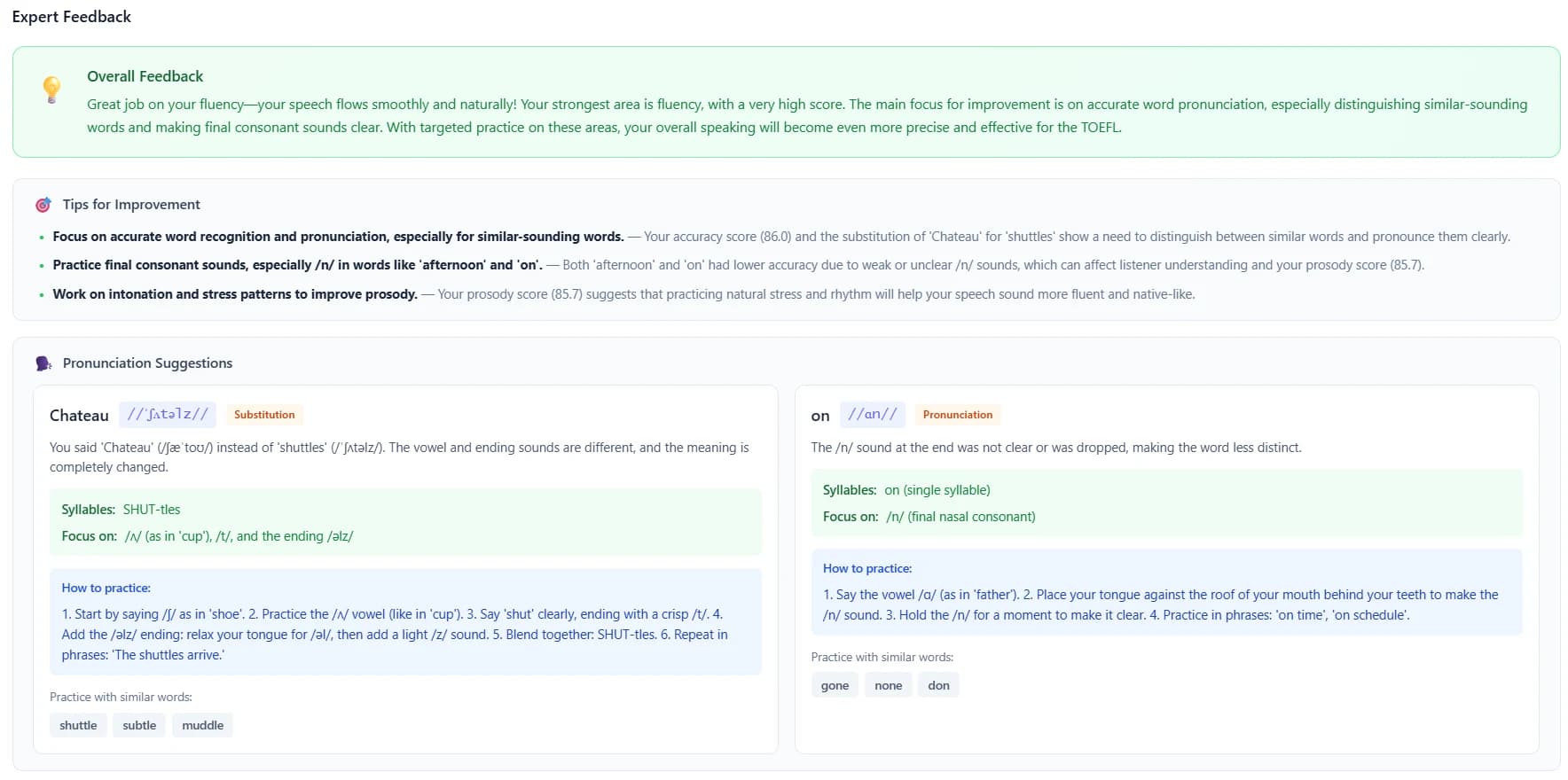
Practice TOEFL Speaking with Rubric-Based Feedback
LingoLeap's AI evaluates your Speaking responses using criteria aligned to each task type — so your practice targets exactly what the rubric rewards.
Start TOEFL Speaking PracticeFrequently Asked Questions
What is the highest TOEFL 2026 Speaking score?⌄
The highest Speaking section score is Band 6 on the TOEFL 2026 1–6 scale. This corresponds to approximately a 27–30 score on the old 0–30 per-section scale and reflects consistently strong performance across both Listen and Repeat and Take an Interview tasks. For mappings between bands and the legacy 0–120 / IELTS / CEFR scales, see the TOEFL Score Converter.
Is Listen and Repeat or the Interview more important for a high Speaking score?⌄
Both task types contribute to your Speaking section score, and consistently strong performance in both is needed to reach Band 6. The Take an Interview task is evaluated on more dimensions (relevance, elaboration, vocabulary, grammar, fluency, pronunciation), which makes it a higher-stakes area for most test-takers. However, accuracy errors in Listen and Repeat are easy to avoid with targeted practice and should not be a weak point — see the Listen and Repeat strategies guide.
Can I reach Band 6 if my accent is strong?⌄
Yes. TOEFL Speaking scoring does not penalize for a non-native accent. What matters is intelligibility — whether what you say can be clearly understood — and naturalness of intonation. You do not need to sound like a native speaker; you need to speak clearly and naturally. Many test-takers with strong accents achieve Band 6 by prioritizing clarity and correct stress patterns. See the official ETS TOEFL Speaking criteria for the full description.
How long should my Interview responses be?⌄
TOEFL Interview responses are not measured by length alone, but Band 6 responses generally include a clear answer and sufficient elaboration. In practice, this typically means 3–5 sentences delivered naturally within the available response time. A response that is too short suggests a lack of elaboration; a response that rushes through content without development is also insufficient. For a structured response framework you can practice with, see the Speaking Interview Template.
Should I memorize speaking templates to reach Band 6?⌄
No. Memorized templates are detectable and can actually lower your score if they make your response sound formulaic or if the template does not fit the specific question. What helps is having a reliable response structure (answer → reason → detail) that you internalize, not memorize. The content of every response should be original and specific to the prompt — see the Speaking Templates collection for adaptable frameworks rather than fixed scripts.
Related Guides
TOEFL Score Hub
All TOEFL score tools and guides in one place.
Read guide →
TOEFL Speaking 2026 Overview
Understand the structure, task types, and timing of the Speaking section.
Read guide →
TOEFL Speaking Templates
Structured response frameworks for the Interview task.
Read guide →
TOEFL 2026 Format and Scoring
How scoring works across all four TOEFL 2026 sections.
Read guide →
What Is a Good TOEFL Score?
See what Band 6 means for university admissions and target score planning.
Read guide →
How to Score a 6 in Writing
The same rubric-based approach applied to the Writing section.
Read guide →
About this guide
Written by Erin (LingoLeap Content & SEO Specialist) and reviewed by the LingoLeap TOEFL Content Team — preparation specialists who analyse ETS official scoring rubrics, test-taker performance data, and examiner feedback reports to produce accurate, rubric-aligned TOEFL 2026 content. All scoring criteria referenced in this guide are derived from ETS published materials. Last reviewed April 30, 2026.