TOEFL Score Gap Planner
Pick your TOEFL 2026 target band, enter your current scores — get a prioritized section-level action plan and a timeline tuned to your weekly study hours (3–40 h/wk).
By Erin, LingoLeap Content & SEO Specialist · Reviewed by the LingoLeap TOEFL Content Team · Last reviewed:
Score Gap Planner
Set your target band and optionally enter current section scores. Get a prioritized action plan to close the gap.
Not sure? Check your school's requirement →
Adjusts the timeline projection. 3 h/wk suits a casual review; 10–15 h/wk is the typical sweet spot; 30–40 h/wk reflects intensive full-time prep.
Turn your plan into practice
Mock tests and AI-scored Speaking & Writing target exactly the weaknesses your gap analysis reveals.
What This TOEFL Score Gap Planner Helps You Solve
Use this planner when you have a target overall band but aren't sure which sections to attack, in what order, or how realistic your timeline is. Each output below is a direct answer the tool gives you.
How big is my gap, and is my target realistic?
Exact gap shown and classified as On Track, Close Range, Stretch, or Major Gap. If even Band 6.0 in your missing sections can't reach the target, the planner flags it and recommends a long-term plan.
Which section should I work on first?
Sections are ranked by gap size with priority badges (Critical, Improvement Needed, On Track) — start with the largest gap. The Section Leverage panel also shows the maximum overall lift each section can contribute, useful for tie-breaking similar gaps.
How many weeks of study do I need?
Weeks-range derived from your gap and the Weekly Study Hours slider (3–40 h/wk) — drag to see how more or fewer hours change the timeline.
What concrete actions should I take?
The Action Plan converts the analysis into a prioritized to-do list — what to drill, in what order, with milestone targets along the way.
From gap → to practice
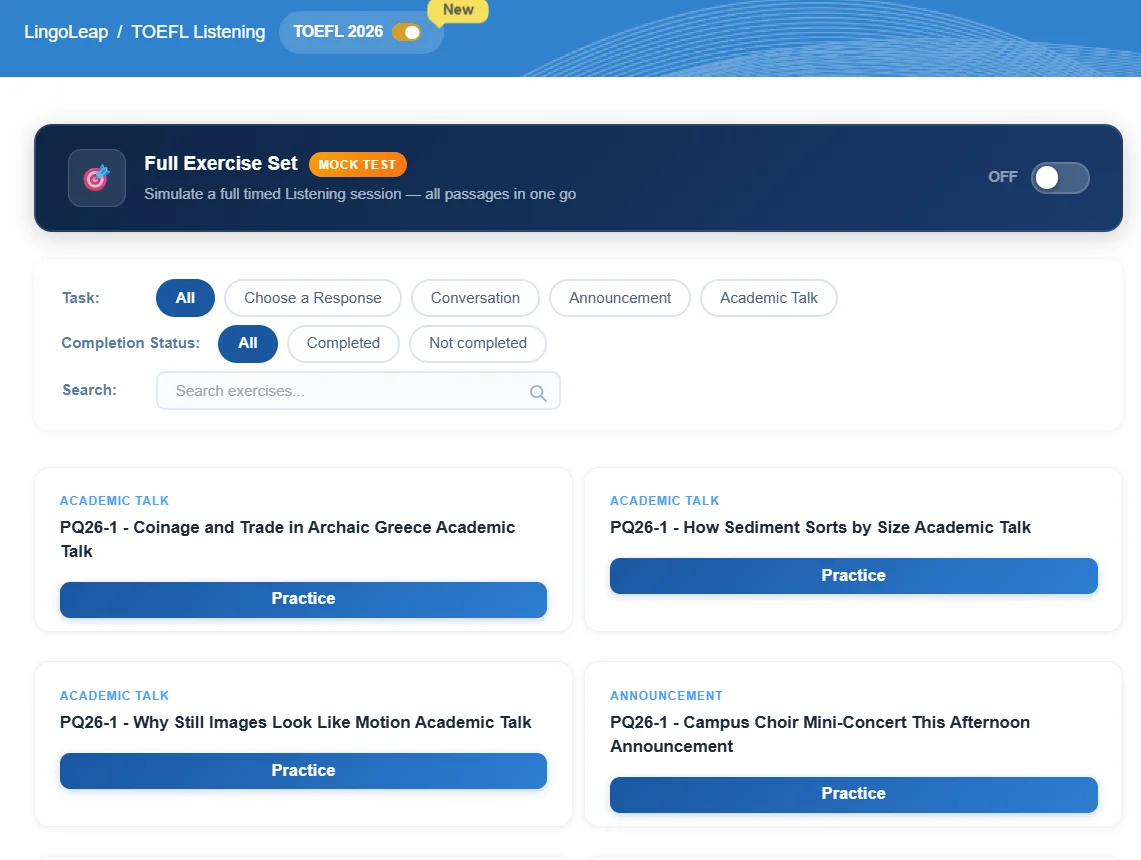
Once you know your weakest section, jump straight into AI-scored exercises on LingoLeap practice to close the gap.
Work on your weak section on LingoLeap to close the gap and reach your target score.
AI-scored Speaking & Writing, full timed mocks, and section-level drills aligned with the TOEFL 2026 scale.
How to Read Your Plan
- •Sections are ranked by gap size — start with the largest.
- •Section-leverage shows how much overall band each section can lift.
- •Timeline assumes 10 h/wk; the slider rescales it to your schedule.
- •Speaking & Writing usually close fastest with AI-scored practice.
Critical — needs work
Gap ≥ 1.0Highest priority — the biggest blocker between you and your target.
Improvement needed
Gap 0.5 – 0.99Secondary priority — close after the critical sections.
On track
Gap ≤ 0Already at or above target — maintain, don't over-invest.
Score data based on official ETS TOEFL scoring guidelines. ETS TOEFL Official Site · Score Requirements
Frequently Asked Questions
What should I set as my target score?
Which section should I focus on first?
Do I need to enter section scores to use the planner?
What does 'Critical — needs work' mean?
How long does it take to close a 1.0 band gap?
Start Closing the Gap
Practice with adaptive TOEFL exercises and get AI-scored feedback on your Speaking and Writing.
Start Free Practice